1:1 meetings at events: business matchmaking without a spreadsheet
Matchmaking rounds get built in Excel and fall apart over chat. We shipped 1:1 meetings: publish when you're free, get booked, and there's a table.
If you've ever organized a round of business meetings, you know the file. It's called something like rounds_final_v4_THISONE.xlsx, it has one tab per day, colour-coded cells that only the person who coloured them understands, and a "confirmed?" column full of question marks.
And you also know the exact moment that file dies: when someone moves a time over chat at eleven at night and nobody updates the spreadsheet.
The pain: coordinating a meeting costs more than having it
For the organizer, business matchmaking is the highest perceived-value activity of the event and the one with the worst effort-to-result ratio. You have to gather everyone's availability, cross-reference it by hand, assign physical tables, notify both parties, and then absorb every change. It's switchboard-operator work that doesn't scale beyond a few dozen meetings, and it consumes the team on exactly the day they're needed most somewhere else.
For the attendee, it's worse than it looks: the meeting they wanted to have never gets scheduled. They run into exactly the right person in a hallway, they say "let's set something up", and that's where it dies. Or they coordinate over chat and both arrive at a packed room with no idea where to sit. The round exists in the program, but not in reality.
A meeting that takes three messages to schedule doesn't get scheduled. Coordination friction eats up the genuine interest.
What we shipped: you publish when you're free, and people book you
We flipped the model. Instead of the organizer building the grid, each attendee publishes their own availability.
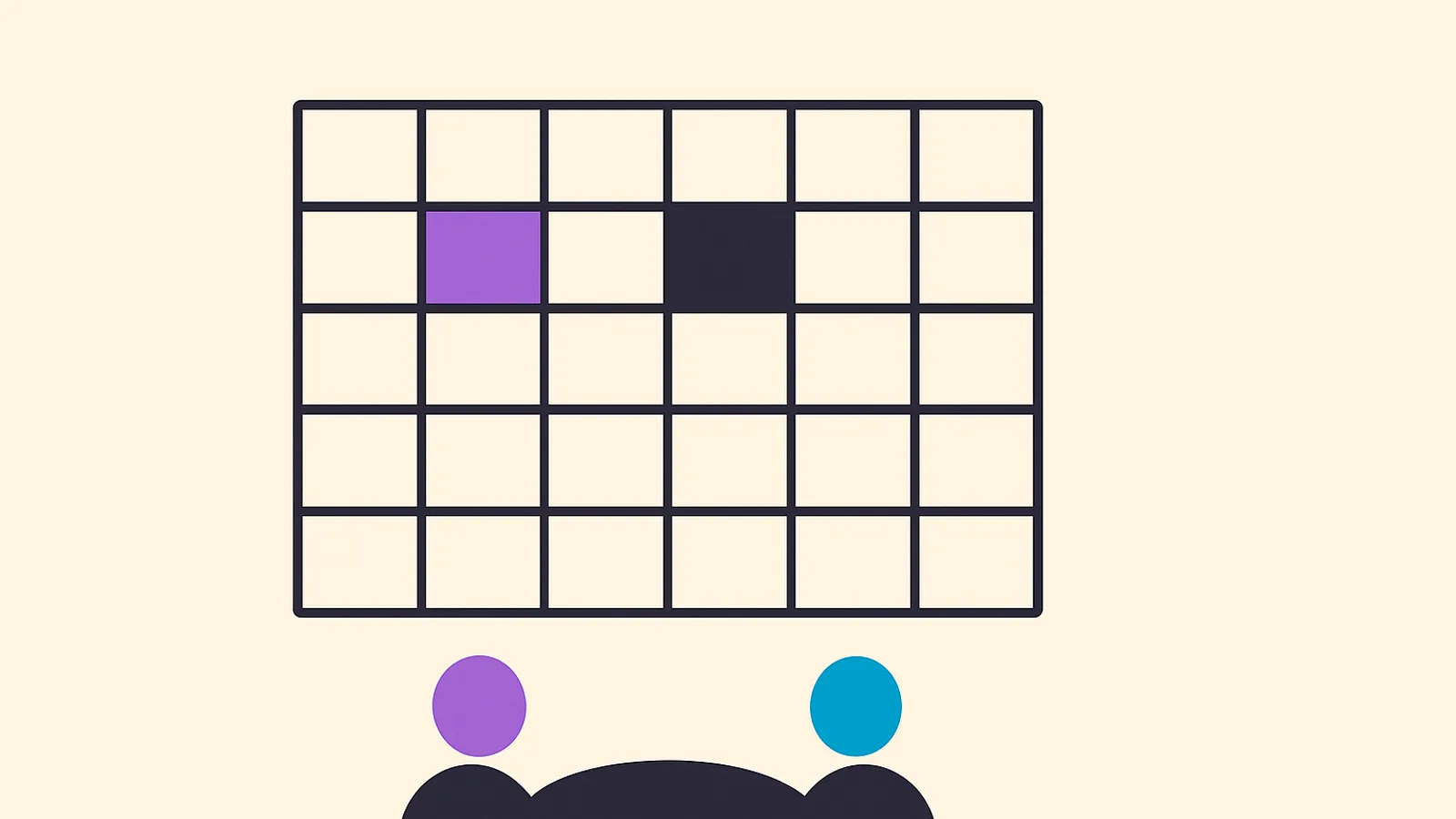
From the event portal, the person opens a visual grid and taps the blocks where they can meet. No typing times, no forms: you tap the squares that work and that's it. They get published as concrete slots, with a real day and time from the event.
On the other side, any attendee with a complete profile sees those openings and books one with a single tap. And here's the decision that changes the most:
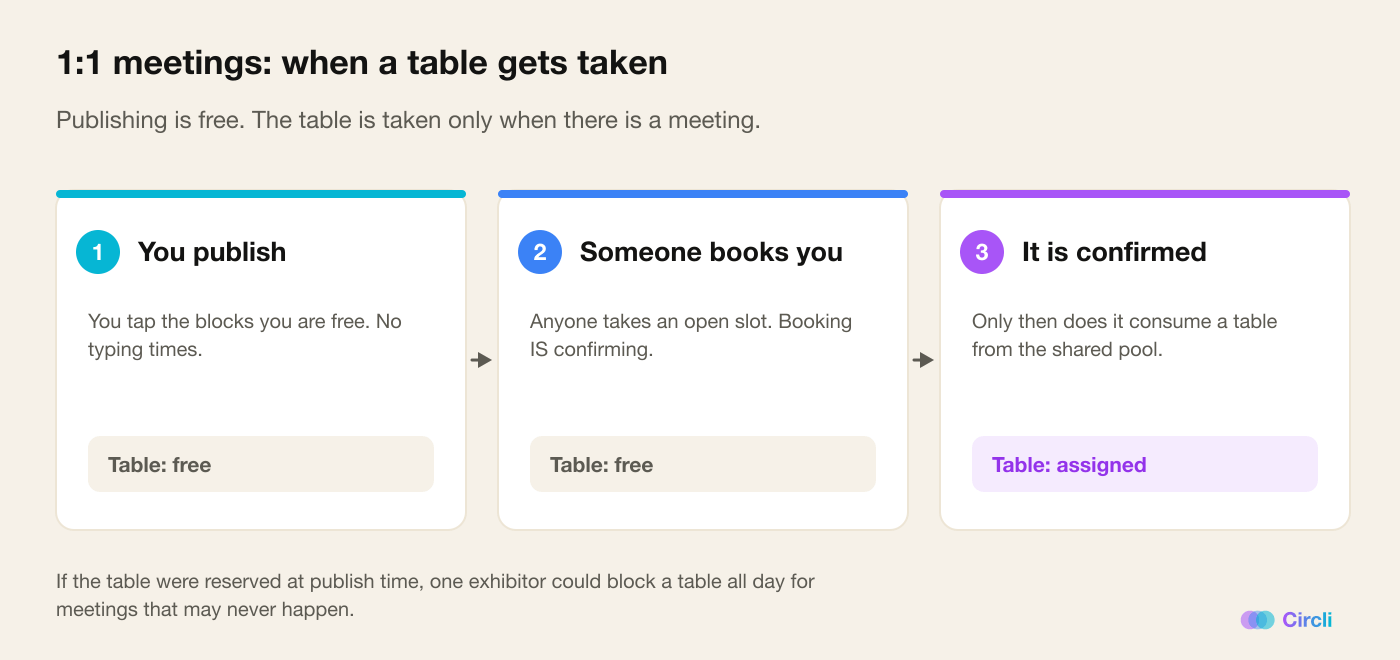
Booking is confirming. There's no request, no waiting for the other person to accept, no "pending approval". You tap an open slot and the meeting is closed instantly — the opening blocks itself and nobody else can take it.
That one change wipes out, in a single move, the back-and-forth that used to kill the meetings. You go from "I message you, you wait, you reply, we confirm" to "tapped, done, see you at 11:20".
Tables get taken when the meeting exists, not before
This detail is technical and it is, for us, the heart of the feature.
An event has a limited number of physical meeting tables. The naive way to handle them would be to reserve the table when someone publishes their availability. We deliberately did the opposite:
Publishing availability is free. The table is only consumed when a meeting is confirmed.
Why? Because if the table were reserved at publish time, one enthusiastic exhibitor could block a table for the entire day for meetings that may never happen. The scarce resource —the physical space— would run out on intentions instead of on real meetings.
With this model, people publish all the availability they like without guilt, and the tables get handed out according to what actually got booked. The organizer defines how many tables there are; the system assigns them as each meeting is confirmed. And if someone would rather host in their own space —"my booth"— they can do that too.
Nobody misses a panel because of a meeting
The second problem with matchmaking rounds is that they compete with the program. Someone books you at three, and three was the talk you wanted to see.
We solved it in two layers:
- The hard block, which the organizer decides on. If it's on, nobody can publish availability on top of a talk in the program. Panel times are closed for everyone, and the round arranges itself around the agenda instead of running over it.
- The personal warning, which is yours. When you're about to book, if the time overlaps a talk you said you were going to, it warns you. It doesn't forbid it —sometimes the meeting is worth more than the panel— but it won't let you trip over it without seeing it.
One protects the event's program. The other protects your day. They're different things, which is why they're two different mechanisms.
Details that matter when real people show up
- Booking the same opening twice is impossible. If two people tap the same slot in the same second, only one wins and the other gets a clear notice that it's already taken. Never two meetings in the same place at the same time.
- Meetings come with a first and last name. There are no pseudonyms here: you book a real person and that person sees who booked them. It's a business meeting, not an anonymous chat.
- You don't have to be in the public directory. You can stay out of the attendee listing and still publish availability and book someone. Choosing not to appear on a list shouldn't cost you the chance to meet the people who do.
- You publish in batches. A single action can create up to twenty openings, so setting up your availability for a whole event is a couple of taps, not an afternoon.
Why it changes the event
For the organizer, the matchmaking round stops being manual labour and becomes a feature of the portal. You define how many tables there are and when, and the rest assembles itself. The team that used to cross-reference availability in a spreadsheet is free to run the event.
For the attendee, the change runs deeper: the meeting they wanted to have actually happens. With a day, a time and a place, without depending on both people remembering to coordinate. It's the difference between leaving with contacts and leaving with meetings — which is, for a lot of people, the only reason they came.
The way we've seen it work best is by concentrating availability in the natural windows of the day —the coffee break, lunch and the networking block— with talk times blocked off. That way nobody has to choose between meeting and listening.
How to turn it on
It's a per-event switch in the organizer panel. When you turn it on you define how many tables are available and, if you want, enable the block on talk times.
One tip: meetings work better if people have already filled in their profile, because publishing and booking both require a complete one. It's worth pushing profile completion a few days early — it's the same profile that feeds the AI matches and the directory.
Running an event with business matchmaking rounds? Discover Circli Events or reach us at events.circli.app.