Event surveys on the phone: NPS and star ratings per talk
Almost nobody answers the post-event form. We shipped feedback on the phone: one star when each talk ends, and a closing NPS in 30 seconds.
The Monday after the event, someone on the team sends the email. Subject: "Tell us how it went". Inside, a link to a twelve-question form that opens by asking for your name and your company.
A handful of people answer it. Almost all of them are the ones who had a great time or a terrible one — the extremes, which are precisely the least representative sample there is. And it arrives late: by the time anyone reads the answers, the event is a memory and the conclusions can't be applied to anything.
The pain: we ask too late, we ask too much, and we ask on the wrong channel
For the organizer, feedback is the raw material for next year and it arrives in an unusable format. A general average ("it was good") doesn't tell you which talk worked, which room was too small, or which speaker is worth booking again. And without that detail, the next event's program gets decided the way it always is: on intuition, and on whoever pushed hardest.
Worse: when it's time to renew sponsors or justify the budget to a board, there's no number. "People left happy" is not a metric.
For the attendee, the problem is friction and timing. They get asked three days later, when they can no longer remember which talk was which. They're asked to open a link, get into a form and write paragraphs. And they're asked when they no longer care — the event is over, they've gone home, they have nothing to gain.
Feedback isn't lost to disinterest. It's lost because it's asked for at the worst possible moment, through the worst possible channel.
What we shipped: asking where people already are
We moved both questions to the only place the attendee is already looking: the phone screen, in the moment. No long forms, no apps to download.
The star, five minutes after the talk
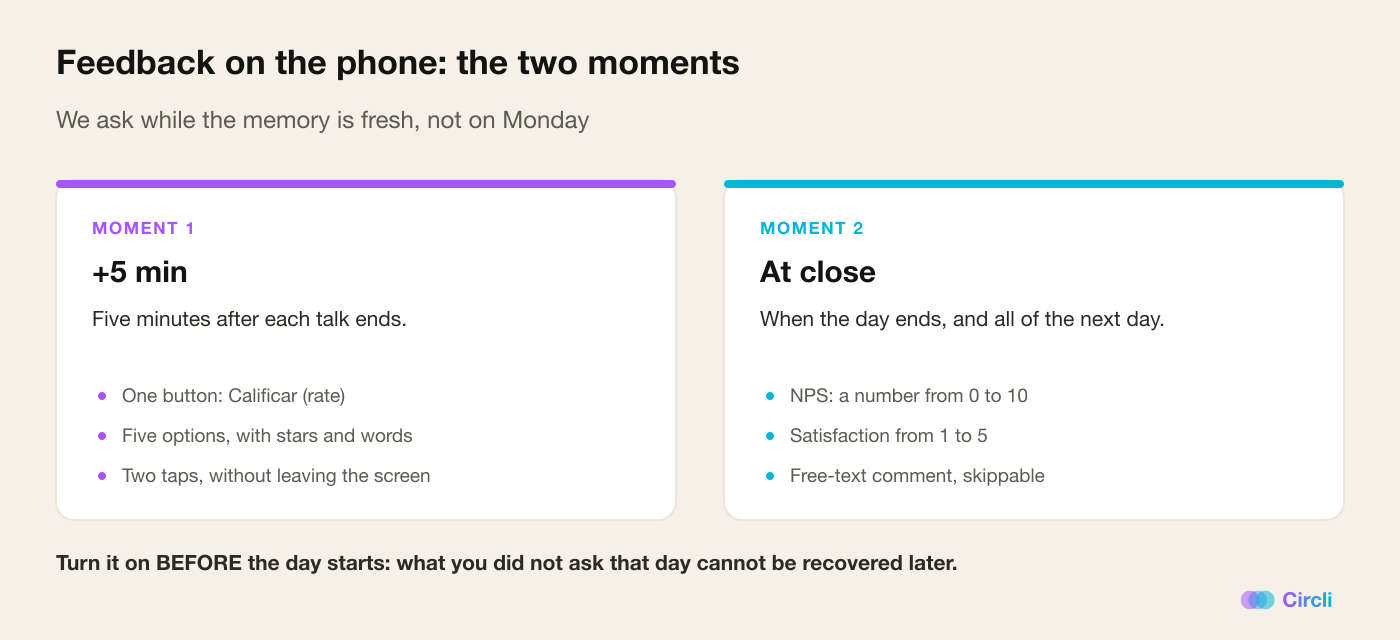
When a talk ends, about five minutes later —just enough time for people to walk out of the room— everyone who signed up for it gets a notice: a line in the event portal's notification bell and a notification on their phone. If the notification goes unseen, the same notice goes out by email.
⭐ How was "Panel: the future of irrigation"? Rate it with one tap.
The notice opens the event's feedback screen: the talk at the top, five stars below it. Tap one and you're done — it's saved.
Two taps in total, about a talk the person has just watched. That's where the whole difference is: we ask while the memory is fresh and the cost of answering is practically zero.
If the organizer turns it on, an optional field to tell us why shows up under the stars. It can be left empty, which is the kind of exit that makes people brave enough to start.
The closing NPS, in 30 seconds
At the end of the day, the notice for the short survey about the whole event arrives the same way. It promises only what it costs:
📋 How was Expo Riego 2026? Two taps to tell us.
It leads to the same screen, with three questions: how likely you are to recommend the event to a colleague, from 0 to 10; overall satisfaction, from 1 to 5; and an open comment, optional. The first two are answered by tapping a number.
One design detail that matters: the window opens at the end of the last day and stays open all of the following day. The person who answers at night and the person who answers at noon the next day both count. Nobody is left out for not looking at their phone at the exact hour.
What the organizer sees
A Feedback tab appears in the panel, with two blocks.
The closing survey shows the NPS, the average satisfaction and the number of responses, with the bar of promoters, passives and detractors. It's the number that works in a report: comparable between editions, understood by any board, and calculated with the standard definition.
The per-talk ratings show each session's star average, sorted best to worst. That ranking is the most useful programming tool you can hand an organizer: on one screen you see which talk to repeat, which speaker to invite back and which format didn't work — with evidence, not impressions.
Everything exports to CSV.
Genuinely anonymous
The results are aggregated and anonymous, and comments are shown without identifying who wrote them.
This isn't a legal detail: it's what makes the data useful. If an attendee suspects their comment has their name stuck to it, they write whatever sounds good. Honest feedback depends on the anonymity being real, and on it being visibly real.
There's a consequence of this worth knowing: if the organizer has comment collection switched off, no comments are collected — not even the historical ones show up later. The knob doesn't filter the view: it filters the collection.
The care it takes to send this to somebody’s phone
Asking on the phone is powerful precisely because it's intrusive, and that forces you to be careful:
- Each talk is asked about exactly once. The prompt is stamped as sent the moment it goes out, so a system retry never bothers anyone twice.
- Anyone who switched notifications off doesn't get them. The Automatic notifications switch in the profile stops both the notification and the email, and every email carries its own unsubscribe link too.
- We don't ask about blocks that aren't talks. Coffee, lunch and check-in don't ask for a rating even though they're on the agenda.
- Nothing is mandatory. You can tap just the star, leave the comment empty or never open the notice: there's no conversation to close.
The warning you'll thank us for
This is the part we most want understood, and we learned it the hard way:
These two features have to be switched on BEFORE the day starts.
They aren't retroactive. What wasn't asked that day can't be recovered afterwards. If the event is over and only then do you remember about feedback, the system's answer is that there's nothing left to do: the talks ended, the window passed, and that data doesn't exist.
It's the kind of mistake you make exactly once, which is why the panel warns you about it: if both are off, it tells you to your face, with the reminder that what wasn't asked doesn't come back.
Why it changes the event
For the organizer, feedback goes from anecdote to instrument. You have an NPS that's comparable year over year and a talk ranking that steers the next program. You stop arguing on the basis of impressions.
For the attendee, giving an opinion stops being a favor asked for by email. It's two taps at the moment they actually have an opinion, and —above all— it's the feeling that someone is asking while it still matters.
And there's an effect we didn't expect: asking in the moment is part of the experience too. An event that asks what you thought of the talk you've just watched feels attentive. One that sends you a form on Monday feels bureaucratic.
How to turn it on
They're two switches in the event settings: Ask about each talk and Final event survey. And a third, optional one, to ask for the comment after the star.
Our advice: turn both on the day before, along with the rest of the checklist. They cost two clicks and they're the only source of truth you'll have about what worked.
Running an event and want to know what actually went well? Discover Circli Events or reach us at events.circli.app.