Trade show gamification: the game that fills the back aisles
The exhibitor in the back aisle sees nobody. We shipped the booth game: scan QR codes, earn points, and a weighted daily prize draw.
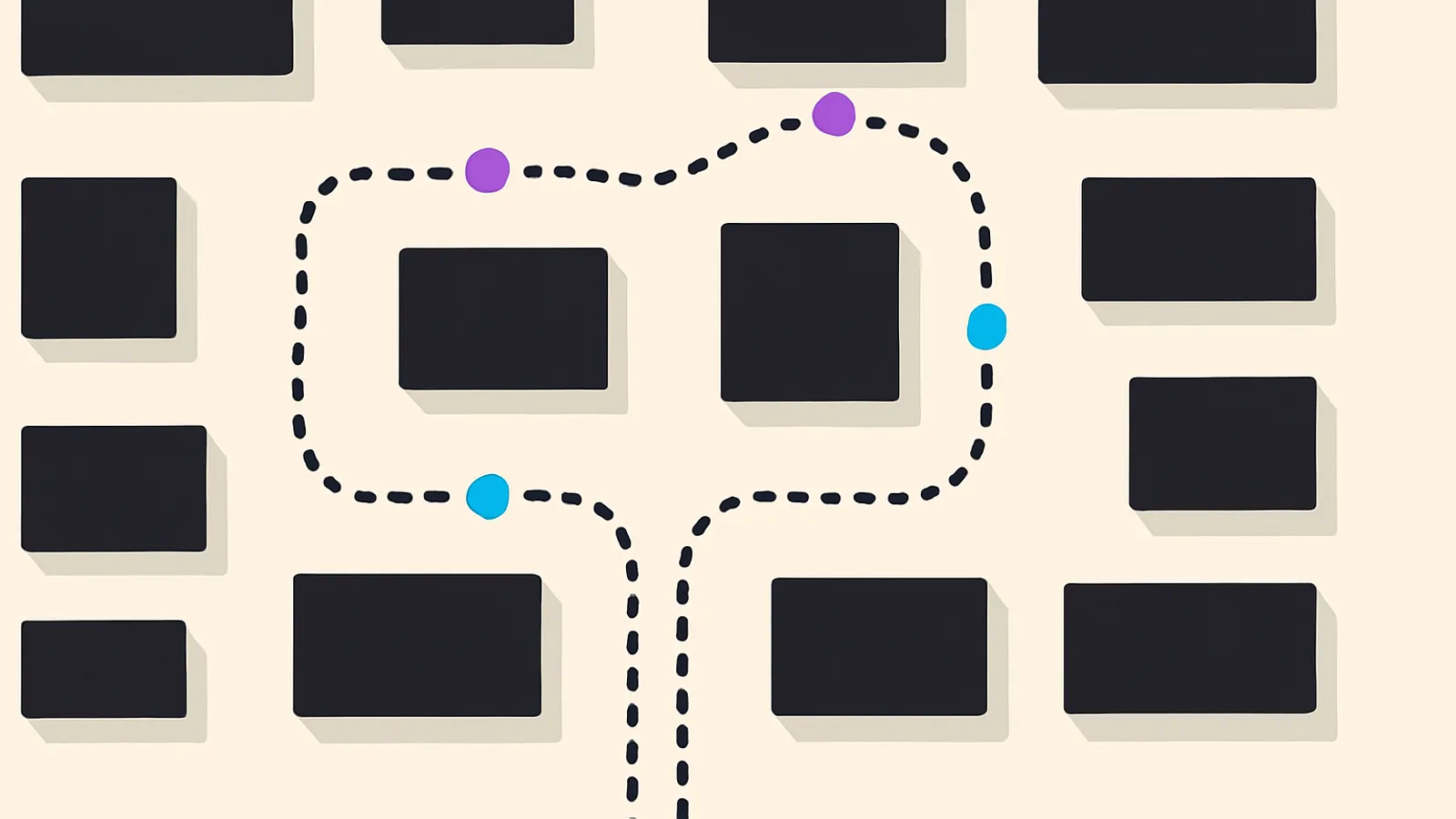
Every trade show organizer knows one map by heart, and it's the map of unfairness. The booths near the entrance watch everybody walk past. The ones in the back aisle, against the wall, next to the toilets, watch nobody walk past.
Both of them paid. One paid less, sure, but they paid. And at the end of the day one leaves with fifty contacts and the other leaves with the feeling of having thrown the money away — which is exactly the feeling that stops them coming back next year.
The pain: the show has dead zones and nobody knows what to do about them
For the organizer, it's a structural problem that goodwill doesn't fix. You can put the catering at the back, you can run raffles over the PA, you can ask people to walk the whole floor. It isn't enough. Traffic at a trade show is defined by the architecture, not by the announcements.
And without data it's worse: you don't know which aisles work, you don't know which booths got visits, and when the exhibitor at the back complains you have nothing to answer with but an apology.
For the attendee, the problem is a different one: walking an entire show is exhausting and there's no reward for it. They see twenty booths, three of them interest them, and they have no reason to walk all the way to the back other than curiosity — which by four in the afternoon has run out.
Nobody walks a trade show for the sake of completeness. They walk it out of interest, and interest is distributed just as badly as the square meters.
What we shipped: every booth is a QR code and every QR code is points
We turned the show into a game, and the game into a concrete reason to walk to the back.
Every booth has its own printed QR code. The attendee scans it from the event portal —which opens in the phone's browser, with no app to download— and scores points instantly. The screen shows what they just earned and how much they have in total.
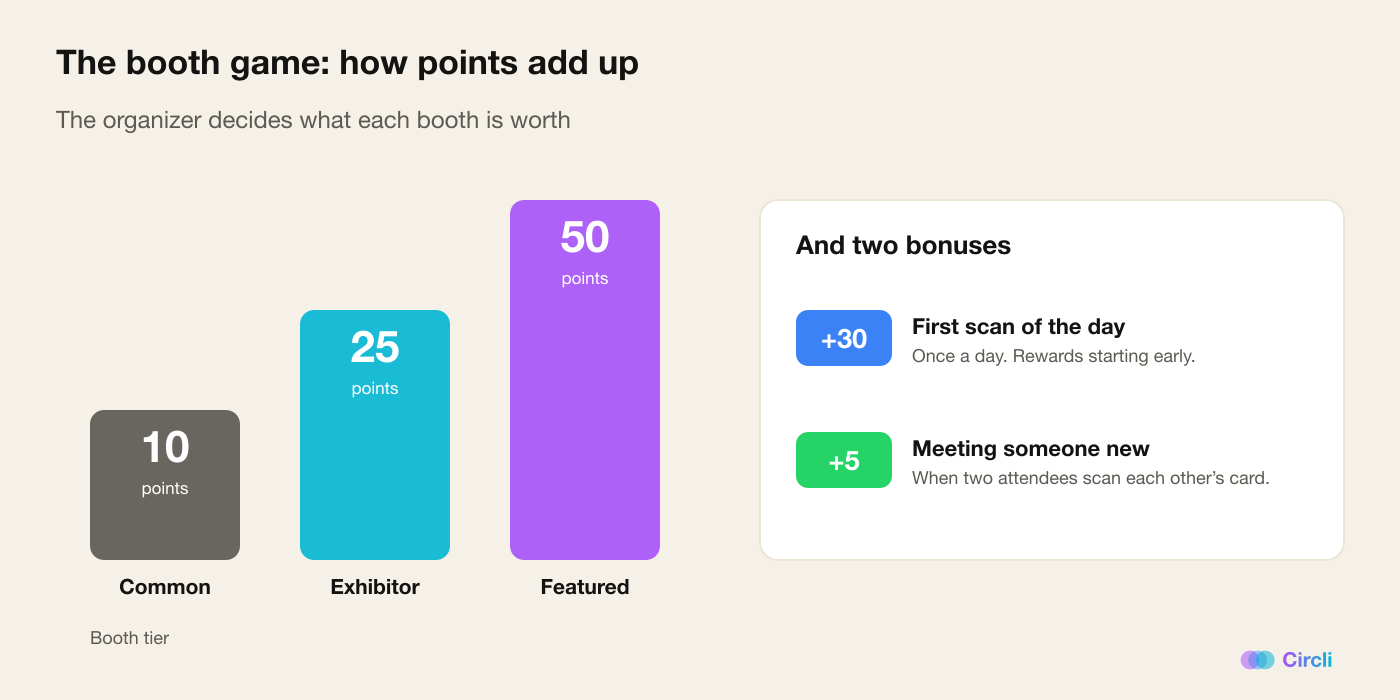
Not all points are equal. The organizer sets each booth's tier, and the tier defines what scanning it is worth:
- Common: 10 points
- Exhibitor: 25 points
- Featured: 50 points
That's the lever that fixes the map of unfairness. You set the booth in the back aisle to Featured, and suddenly walking over there is worth five times more than hanging around the entrance. Traffic stops depending on the architecture and starts depending on a knob you control.
There are also two bonuses that push the right behavior:
- +30 points for the first scan of the day, once per day. It rewards starting early instead of turning up at the last minute.
- +5 points for meeting someone new: they go to whoever does the scanning of the other person's digital card. The points are one-sided on purpose — if both sides earned them, the winning move would be to stand still and let people scan you. The game doesn't only reward walking around: it rewards going out to meet people.
The draw, and why it isn't a raffle drum
This is the part that was hardest to design well, and the part we're proudest of.
At the end of each day the organizer goes in, picks a prize and taps Draw winner. The system picks at random — but weighted by that day's points. Whoever took part the most has the best odds. It isn't a raffle drum where the person who showed up at six in the evening competes on equal terms with the person who walked the entire show.
And there's one detail that changes behavior in the last hour: recent activity counts for more. Points from the last 30 minutes count multiplied, so being there when the draw happens genuinely pays. It's the difference between a hall that empties out at five and a hall that stays full until the draw.
There are no thresholds and no sign-up. Every attendee with points that day is entered automatically. Nothing to register for, nothing to claim, no fine print.
The cheaters, and the people who want out
Two decisions that determine whether a game like this can be used seriously.
The first: the anti-fraud rule. If someone scans more than five different booths in ten minutes, they aren't walking a trade show — they're walking around with the phone pointed at everything. Those accounts are left out of the draw, but they keep playing: they keep their points, they stay on the leaderboard, and they get no warning and no accusation. We don't want to accuse anyone over an odd pattern; we just don't want the prize going to someone who broke the game.
Before drawing, the organizer sees a preview: who is in, with what weight, at what probability, and how many were excluded for suspicious activity. What's on the screen is exactly the pool the draw runs on — there's no way to hit "Draw" on a different pool than the one you were shown.
The second: the right to be forgotten actually works. An attendee can delete their game data whenever they want. And when they do, they are genuinely out of the draw — not on paper, but in the query that picks the winner. We cared enough to write specific code for it: without that care, someone who asked to be deleted could be drawn and announced over the PA with their full name. That, besides being wrong, violates Ley 25.326, Argentina's data protection law.
Printing the QR codes is one button
The prep work for a game like this could be a design nightmare. We solved it with two buttons.
You can download a single booth's QR code, or print them all at once: a sheet opens ready to print or save as PDF, one booth per page in A5 portrait, with a big QR code and the exhibitor's name. Send it to the printer and you're done.
And the QR codes carry the event logo in the middle, with the error-correction level set high so the code still reads exactly the same.
Why it changes the event
For the organizer, gamification stops being decoration and becomes a circulation tool. You can steer traffic to wherever you need it: the weak aisle, the sponsor who wants more flow, the new section nobody knows about. And for the first time you have the data: which booths were scanned, how many times, at what point in the day.
For the exhibitor, it's the difference between waiting and receiving. A booth with a QR code and a good tier gets visits by design, not by luck of location.
And for the attendee, the show stops being a walk with no purpose. There's a reason to turn down that aisle, and at six in the evening there's a reason to still be there.
How to turn it on
It's a per-event switch in the organizer panel: turn it on, load the booths with their tier, load the prizes with their stock, and print the QR codes.
One piece of game-design advice: don't put everything on the Featured tier. The points system works because there's a difference. If every booth is worth the same, you're back to the map of unfairness — only now with QR codes.
Running a trade show with exhibitors? Discover Circli Events or reach us at events.circli.app.