Mi Tarjeta and Mi Red: event networking without dictating a number
Three weeks later nobody remembers who the crumpled business card belonged to. We shipped Mi Tarjeta and Mi Red: scan the QR, and you're connected.
Everyone has the drawer. The one where business cards from the last trade show go to die: fifteen, twenty little rectangles with nice logos and names that no longer mean anything. One of them has a scribble on it —"call", "supplier?", an arrow— and none of them has the only thing that mattered, which was why you wanted to talk to that person in the first place.
That drawer is where networking goes to die. Which is strange, because networking is literally the reason most people bought the ticket.
The pain, on both sides of the counter
We hear it at every event we work, and it always comes in pairs.
On the attendee's side: you meet someone interesting at the coffee break. You both pull out your phones. Someone dictates a number, the other person fat-fingers a digit. Or worse: you swap paper cards and promise to write, both knowing you won't. Asking a stranger in a hallway for their phone number is awkward, and awkward doesn't scale. By the end of the day you met ten people and you can reach three.
On the organizer's side: you sold a networking event and you have no way of knowing whether the networking happened. The room filled up, people left happy, and? Not a single data point. When the sponsor asks "what do I take home?", the honest answer is a photo of a busy booth.
The problem was never that people didn't want to connect. It's that the ritual for doing it —paper, dictation, promise— was broken before the smartphone even existed.
What we shipped: Mi Tarjeta and Mi Red
We gave every attendee two things inside the event portal, which opens in the phone's browser and requires no app download.
Mi Tarjeta ("my card") is their digital credential: a personal, unique QR code that lives on their profile. Nothing to print, nothing to request. It's there from the moment they enter the portal.
Mi Red ("my network") is the address book the contacts land in.
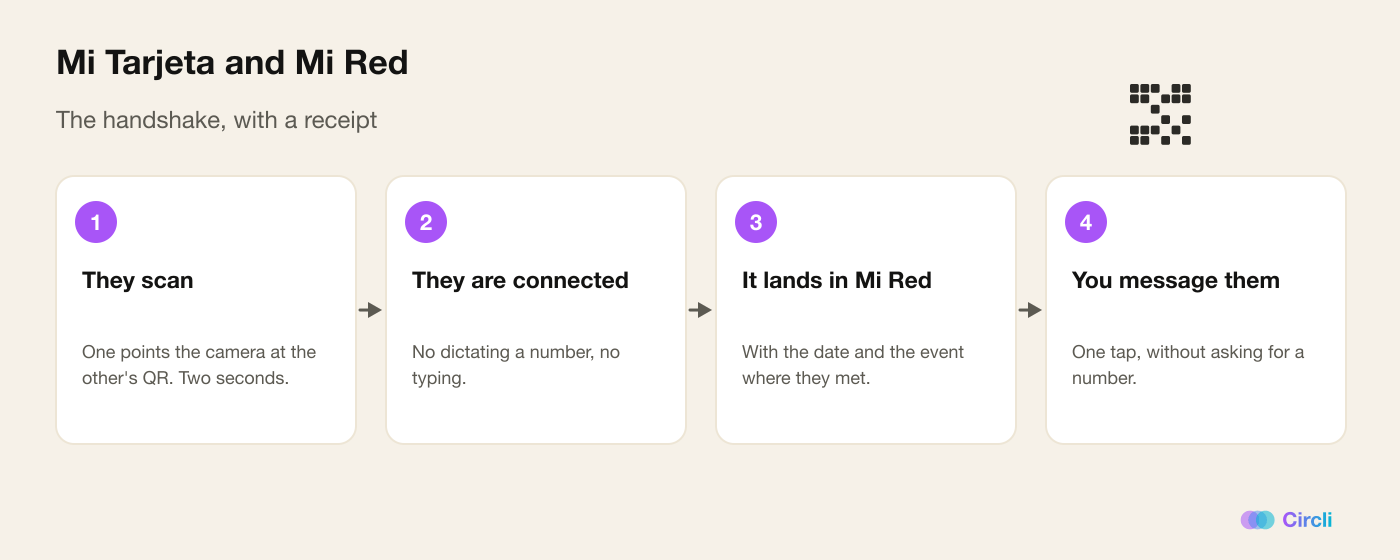
And one single gesture connects the two: one person scans the other's QR with their phone camera, and they're connected instantly. No dictating numbers, no asking for a phone, no typing. The contact is saved in Mi Red, and from there they can message each other in one tap, without either of them having dictated a number.
It's the handshake, with a receipt.
Why the scan matters (and isn't a technical detail)
There's a design decision here we're proud of, and it's about privacy.
At Circli, scanning the QR is the consent. When two people scan each other they are performing the contact exchange explicitly, in person, and mutually — exactly like handing over a card, minus the paper. That's why a Mi Red connection shows the other person's contact details: both parties made a deliberate move.
What we do not do is the opposite: we don't publish anyone's contact details by default, we don't let anyone download the attendee list, and we don't turn an event into a database to be sold. The difference between "we met" and "you were on the same list as me" is the whole difference, and it's written into the code, not into the terms and conditions.
Mi Red is not the attendee list
It's worth drawing the distinction, because these are two things that look alike and aren't.
The event directory is who's here. It's for searching, for discovering, for seeing which companies came — and each person decides how much of themselves to publish there.
Mi Red is who you actually met. It's smaller, it's yours, and it's the only list that grows through a deliberate act by both parties.
That distinction is what makes Mi Red useful three weeks later. An attendee list is noise: two hundred names, of whom you spoke to seven. Mi Red is the seven. And each of them is there because both people pulled out a phone and decided yes.
Inside each contact is whatever that person chose to share, and the button to message them without having to ask for their number — which is, in the end, the only thing that was ever needed.
Why it changes the event
For the attendee, the change is that they take something home. Not a tote bag of brochures: a list of people they genuinely met, with their details, one tap away. The value of the event stops evaporating on Sunday.
For the organizer, the change is that networking finally leaves a trace. It stops being a promise in the brochure and becomes something that happens, gets counted, and can be shown. When you have to renew the sponsor or justify the budget next year, you'll have something better than a photo of a busy booth.
And there's a second-order effect we didn't expect: people scan far more than they dictate. Pulling out a phone and pointing the camera is a two-second gesture that doesn't interrupt the conversation. Asking for a number does interrupt it, which is why the number often never gets asked for. Lowering friction doesn't just improve an existing ritual — it makes one happen that used to be abandoned halfway through.
How to turn it on
If you already use Circli, Mi Tarjeta and Mi Red come with the event portal: there's nothing to configure. Everyone who walks in has their QR from minute zero.
One more thing worth knowing, because it matters: that same QR is the person's credential for the entire event. It's the one used at the door, at the booths and everywhere in an event where somebody needs identifying. One code, issued once, never regenerated — because a code that gets regenerated is a code that locks out whoever already saved it.
Running an event and want people to leave with their contacts already saved? Discover Circli Events or reach us at events.circli.app.